

Young Inventors, lesson 3 of 24
What is a Battery? Polarity, voltage and how to test one

Introduction
Your TV remote, your torch and your toy car all keep working without being plugged into the wall. What's their secret? A battery: the most common power source for our electronics.
In this lesson you'll find out what a battery is, why it has a + and a − end, and how to check if a battery is still full.
Working principle
A battery stores energy as chemicals inside it. When you connect it into a circuit, the chemicals slowly react and push electricity out of one end, through the circuit, and back into the other end. When the chemicals are used up, the battery is "flat".
Inside, a battery is made of one or more cells. A single AA or AAA cell pushes with 1.5 volts (1.5 V). A square 9 V battery is really six small 1.5 V cells stacked inside one case: 6 × 1.5 V = 9 V.
Polarity: the + and − ends
Every battery has two ends, called poles: positive (+) and negative (−). Which way round a battery goes is called its polarity.
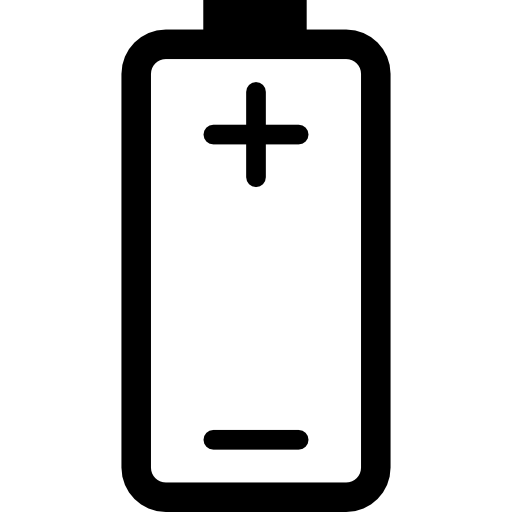
- On an AA or AAA battery, the end with the bump is +. The flat end is −.
- The + end is the higher "hill", so electricity flows out of +, around the circuit, and back into −.
- If you put a battery in upside down, the push goes the wrong way. That's why your remote stops working when a battery is the wrong way round. Look for the + and − marks inside the battery box.
Batteries in a row
When you put batteries end to end (+ touching −), their pushes add up. Two 1.5 V batteries in a torch give 1.5 V + 1.5 V = 3 V. It's like stacking two hills on top of each other.
What you'll need
- Two AA batteries (one new, one used if you have it)
- A battery holder for two AA batteries
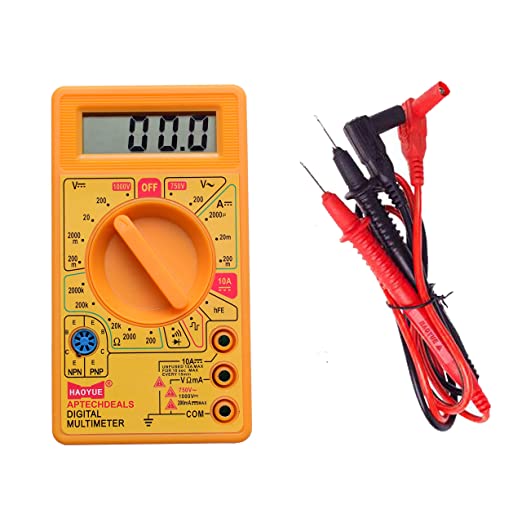
- A multimeter, the tool engineers use to measure voltage
- A grown-up, the first time you use the multimeter
Circuit diagram
Engineers draw circuits using symbols instead of pictures. In the symbol for a battery, the long line is + and the short line is −.
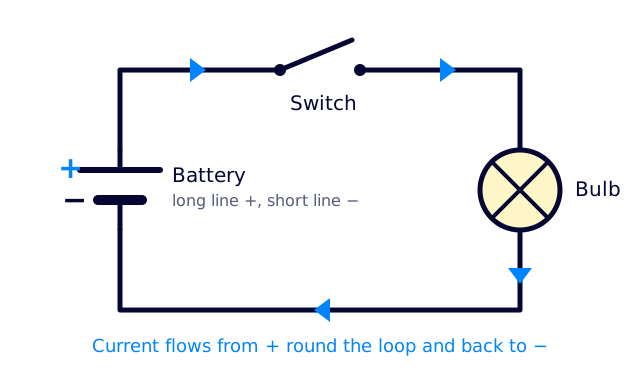
This is the circuit inside a torch. Electricity leaves the + end of the battery, goes through the switch, lights the bulb, and comes back to the − end. When you switch off, the loop is broken and the flow stops.
Working in real life
Let's measure the voltage of a battery, just like an engineer.
- Turn the multimeter's dial to DC volts: the V with a straight line above it (⎓). If it has ranges, pick 20 V.
- Plug the black lead into the socket marked COM, and the red lead into the socket marked V.
- Touch the red probe to the battery's + end (the bump) and the black probe to the − end (the flat side).
- Read the screen. A new AA battery shows about 1.5 to 1.6 V. If it shows less than about 1.2 V, it's nearly flat.
- Now swap the probes round. You'll see a minus sign in front of the number. That's the multimeter telling you the polarity is reversed.
Before digital multimeters, engineers used a voltmeter with a needle, like this one. It measures the same thing: how hard the battery pushes.
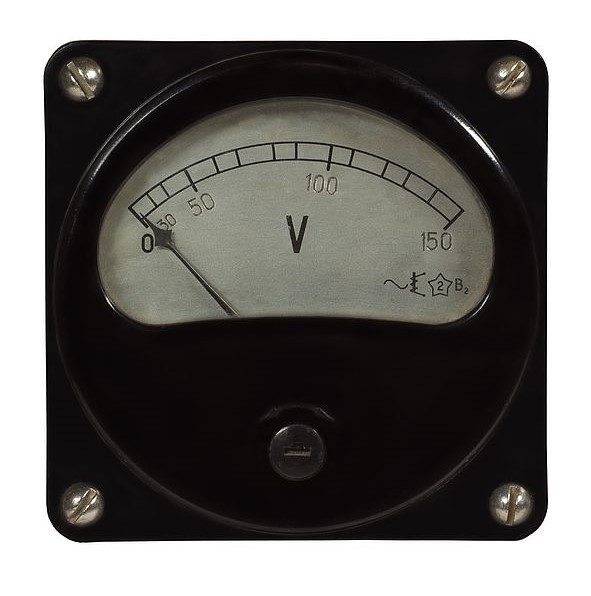
A voltmeter is always connected across the thing you're measuring: one probe on each end.
Try it
- Measure two batteries from around your home. Which one is fuller?
- Put two AA batteries in the holder and measure across both of them together. Do you get about 3 V?
- Look inside your TV remote. Can you find the + and − marks that show which way round the batteries go?
Check what you learnt
How can you spot the + end of an AA battery?
You put two 1.5 V batteries end to end in a torch. How much push do they give together?
Your multimeter shows −1.5 V. What does the minus sign tell you?
Conclusion
- A battery stores energy as chemicals and pushes electricity around a circuit, like a water tank on a hill.
- Every battery has a + end (the bump) and a − end (the flat side). Electricity flows out of +, round the circuit and back into −.
- A multimeter set to DC volts tells you how much push (voltage) a battery has left. A new AA shows about 1.5 V.
What next?
Batteries give one kind of electricity. Your wall socket gives another. Find out the difference: What is AC and DC? Is it harmful?